Key Features & Optimizations
Optimized for High-Throughput (Caching)
Unlike standard pymatgen tools, this library is specifically designed to handle huge numbers of VASP outputs efficiently.
Persistent Caching: The core
IMDGVaspDirclass implements a persistent disk cache (stored in~/.cache/imdgVASPDIRcacheorXDG_CACHE_HOME).Lazy Loading: Parsed VASP data is cached automatically. Subsequent analysis of the same directories is orders of magnitude faster, making it feasible to analyze thousands of calculations repeatedly without re-parsing XML or OUTCAR files.
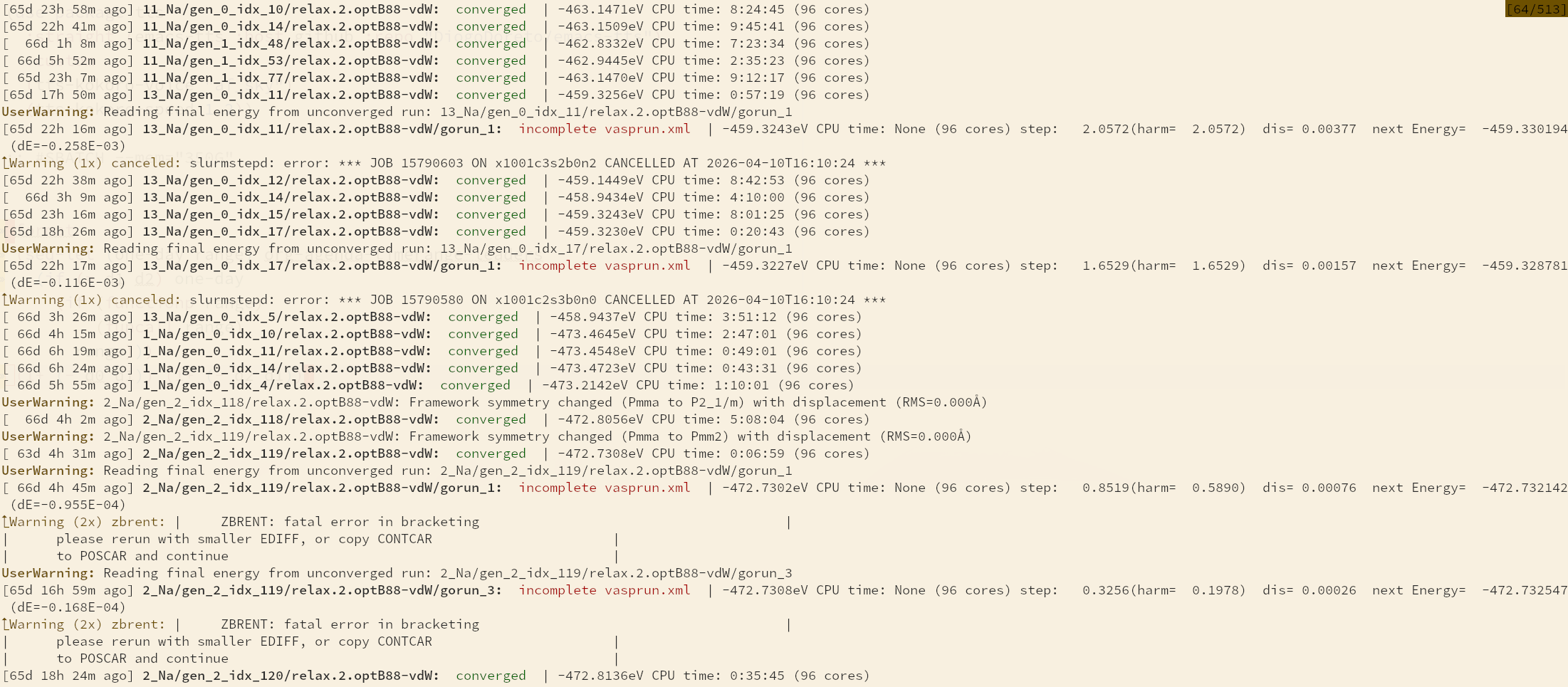
Automated Health Checks & Warnings
The library proactively monitors VASP calculations for common pitfalls, essential for reliable high-throughput workflows:
VASP Warnings: Automatically parses logs (e.g.,
vasp.out,slurm*.out) to surface execution warnings like convergence failures or grid errors.Structural Integrity: Checks for physical anomalies during relaxation to catch problems early:
Large Displacements: Warns if atoms move significantly more than expected (e.g., indicating bond breaking or phase instability).
Symmetry Changes: Detects if the framework symmetry breaks during relaxation, which often indicates a failed calculation or unwanted phase transition.
Stress & Forces: Monitors for unexpected hydrostatic stress or excessive residual forces.
Example output:
Extensions to pymatgen
While heavily based on pymatgen, this library introduces several key
differences:
imdg analyzevspmg analyzeThe
imdg analyzecommand is built on the cachingIMDGVaspDirclass.It focuses on relative changes: instead of just reporting absolute values, it calculates changes between the initial and final structures (e.g., volume change
%vol, lattice parameter changes%a,%b,%c, and total atomic displacementdispl).It supports grouping runs by identical
INCARparameters to easily compare different calculation settings.
Enhanced Input Sets: New input sets like
IMDDerivedInputSetallow deriving new calculations (relaxations, strains, NEB) directly from existing output directories, preserving context/history.
Getting Help
Command Line
You can get help for any command directly in the terminal:
# General help and list of subcommands
imdg --help

# Help for a specific subcommand (e.g., arguments for analyze)
imdg analyze --help
imdg derive . ins --help
Python Code
All classes and functions are documented with docstrings. You can
access them using Python’s built-in help() function:
from IMDgroup.pymatgen.io.vasp.vaspdir import IMDGVaspDir
help(IMDGVaspDir)
Installation
git clone https://git.sr.ht/~yantar92/IMDgroup-pymatgen
cd IMDgroup-pymatgen
pip install .